Tuesday, September 3, 2013

Science: Fonterra

In the last holidays I spent a lovely day at MOTAT.
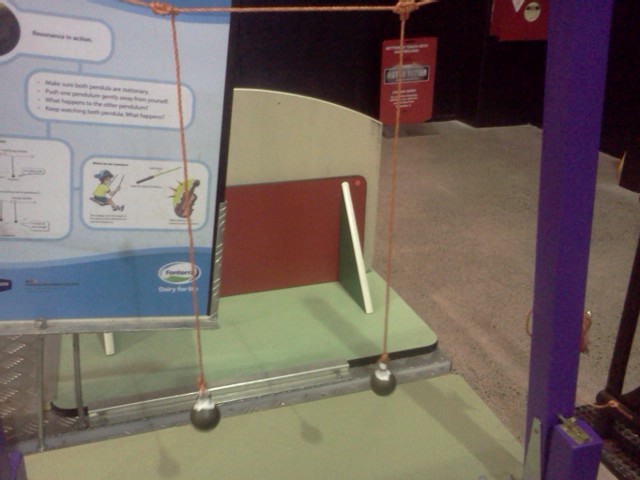
 Fonterra, although they have a  bad rep at the at mo, put on a great science fair. I managed to put take some pictures that got me thinking about Science, forces, friction and energy.
Swinging pendulum. Watch how the force is transferred.

Roll the two balls from different heights and see them ALWAYS meet in the middle.

Roll two marbles from the top. Which marble reaches the bottom first.

Wednesday, August 7, 2013

Stage 2 Maths

Let us not forget, as I did the other day, that level 2 of the New Zealand Curriculum does not equate to stage 2 in the Numeracy Project (NUMP).

I collected a series of 'Figure it Out' books for a maths taskboard activity the other day and the lovely, kind maths adviser smiled sweetly at me and informed me that the levels marked on the bottom were in fact NZ curriculum levels and not NUMP levels. 

Here's a breakdown, so I don't forget again.

NUMP level
New Zealand Curriculum level
1
1
2
1
3
1
4
1
5
2
6
2/3?
 

Additonally I've put together the Level 2 (NZC) problems on a helpful pdf. Here's an example:


The Problem
Mary had a $5 note. She exchanged it with her brother Sam for some coins.
Could shehave exchanged it for 6 coins?
What is the largest number of coins that Sam could have given Mary?
Word problems resource level 2 A5 size (198.2 KB, pdf) 


Te Toi Tupu – Maths focus on Measurement


First day of school and it’s a teacher only day. I’m not being paid for it but I need the PD.
The maths advisers from Te Toi Tupu came to school. We discussed Geometry and the teaching of measurement.
As a reliever visiting each class a couple of times a term I found this session amazingly helpful.  Taking a strand like this into the classroom is going to be so much easier than trying to teach number knowledge or strategy. The planning and delivery of those to are very specific, targeted to small groups and individuals and a there is a lot of room for error as I found last Monday.
So bring on the teaching of Strand is what I say.
The sessions and activities are very ‘discovery’ orientated, with practical activities and the opportunities presented to students to ‘figure it out’ themselves. 


     Identify
The first step in the measuring process is understanding that objects have attributes that can be measured. Initial experiences are needed to develop awareness of the attribute and to introduce the necessary language, for example, big, heavy, tall, empty.

 Compare and Ordering
When students are aware of the attribute being investigated they should be given opportunities to compare different objects. Adults realise that to say something is "long" does not have a lot of meaning. "Longer than what?" is a usual response.

 Non-standard units of measure
Some form of unit needs to be used if a question such as "How much longer is your pencil than mine?" is asked. Non-standard units are ordinary objects which are used because they are known to students and are readily available, for example, paces for length, books for area and cups for volume.

 Standard
Some form of unit needs to be used if a question such as "How much longer is your pencil than mine?" is asked. Non-standard units are ordinary objects which are used because they are known to students and are readily available, for example, paces for length, books for area and cups for volume.

 Applying
When students are comfortable and efficient in measuring and estimating using appropriate standard units, learning experiences can be directed towards applications of measurement and to the use of measurement formulae.
6.       Using appropriate units
SI Units used in school measurement
Length
metre (m)
Area
square metre (m2)
Volume
cubic metre (m3)
Mass
gram (g)
Time
second (s)
Non SI units
Time
minute (min) hour (h)
Angle
degree of plane angle (O)
Temperature
degree Celsius (OC)


Resources:

Thursday, July 25, 2013

Taskboards: Reading, Writing and a vague Maths one

So its not so flash or interesting but still a necessary component of the planning process. I've jsut spent this morning collating all my resources, collected and created over the past week and built a series of taskboards for the coming term. The Maths taskboard needs fleshing out with the specific tasks.  I visit each classroom twice in the term so I will two taskboards and the associated activities but what I created here should last me for the next four or five weeks. Fingers crossed.  This purely for my benefit but thought I'd share it anyway.


Tackboard download includes: Senior and Junior Reading, Senior and Junior Writing, Senior and Junior Maths.

Wednesday, July 24, 2013

Teacher Pay Teacher

There are a truck load of resources available on Teacher Pay Teacher. And some of it is free. For example:

Daily 5: Posters and Rotation Cards!

Use these posters and rotation cards to facilitate The Daily 5 in your classroom! Posters include Word Work, Read to Self, Read to Someone, Listen to Reading, Work on Writing and an additional Work with the Teacher card. Thanks One Extra Degree

Guided Reading Prompt Cards

This resource includes 24 eye-catching prompt cards for during guided reading. During reading breaks, a student can choose a card and complete the task or answer the question. Thanks Shelley Gray

FREE 8 Reading Strategy Posters!

Use these bright and colorful posters at centers or to decorate your classroom. A great way to remind students to use their reading strategies! Thanks Rachel Lynette

Elementary Poetry Collection 

Here is a collection of poems and activities that I put together to use throughout the year with my students. None of the poems are original- but they sure are fun to learn! There are poems related to each month, season, and holiday throughout the school year. Thanks Mary Lirette

Noun, Verb, and Adjective Sort 

This download contains a Noun, Verb, and Adjective Sort with a sorting mat, 24 word cards to sort, and a recording sheet. Thnaks Jamie Rector

Additional Free resources

There are other great free resources on TeacherPay Teacher. These are focused around Reading for lower primary as that was what I'm researching now but its worth digging around this site. Especially if you hold a small classroom budget or can sweet talk your literacy coordinator. 

Learning letters and handwriting activites for Early primary

Letter Scavanger Hunt

This activity takes some adapting. The article from Jackie, author of Ready. Set. Read! is geared around pre-schools and spelling your name in the first instance. But I would share together a fairy story and brainstorm others they know. Just to assist the students in getting in the right mindset. Then they could follow the string around the classroom/ playground to find the letters to spell a popular fairy story. They then have to work together to spell the name correctly.

Learning letters

On this website are a plethera of activity sheets for each letter of the alphabet. From tracing letters to printing words and colouring pictures. The only snag I've found for these is that you will have to copy and paste the area into WORD before printing otherwise formatting tends to be lost. A pain I know but better than drawing the pictures yourself!

Handwriting letters

Lucy Yates put together some handwriting practice pages for the letters. You will have to sign up, free, to TeachersPayTeachers. But its worth it.

Further Resources for the Reading taskboard

I have just created my Pinterest account and as soon I work it out a little more I'll place the link somewhere on my blog.

In the meantime I've been looking around for further resources to support my literacy taskboard  programme.

Senior Reading

Paper chain connections

Cut the strips apart and fill out the top strip with the title, author, and your name. As you are reading and make a connection, decide whether your connection is to something you have experienced, to another book or author, or to something happening in the world. Briefly explain the connection on the paper strip, circle the type, and include the page number.

Charater Read and Roll

Start with a basic stick figure of your character. Write the book title, name of the character, and your name below the character. As you add each of the following to your drawing, be sure to include important details that give us information about your character. 
 

Other Resources from Laura Candler's Teacher Resources

Below is the link to the section of the Teacher Resource website I found the above resources I am hoping to use. There are many more that may help you. Laura opens her site by saying " Enjoy this collection of engaging literacy printables that help make teaching reading easy!"

Literacy station

Belinda Kinney is a 2nd grade teacher in Plano, Texas. Her series  of literacy activities are ideally suited to Y3-6. She covers a variety of topics from word level, sentence and grammar to text level and promoting higher order thinking and independent learning.
Resource Created by Belinda Kinney